Documentary Knowledge Centre
Varanasi Glossary
A concise guide to recurring names and terms used in the Varanasi journey and Knowledge Centre.
Related place: Varanasi · Uttar Pradesh
Varanasi · Banaras · Benares · Kashi
Varanasi is the modern official English name. Banaras and the older English spelling Benares remain widely recognized. Kashi is an ancient name with especially strong religious associations. The archive may use different forms when historical context or a quoted source makes one form more appropriate.
Ganga · Ganges
Ganga is the name commonly used in Indian languages and in Hindu religious contexts; Ganges is the long-established English form. Both refer to the same river. The website may use “Ganges” in general English prose and “Ganga” where the devotional or Indian-language context is important.
Ghat
A ghat is a stepped approach to a river or other body of water. In Varanasi, the term also identifies named sections of the riverfront with their own histories, architecture and uses. The ghats are not interchangeable scenery.
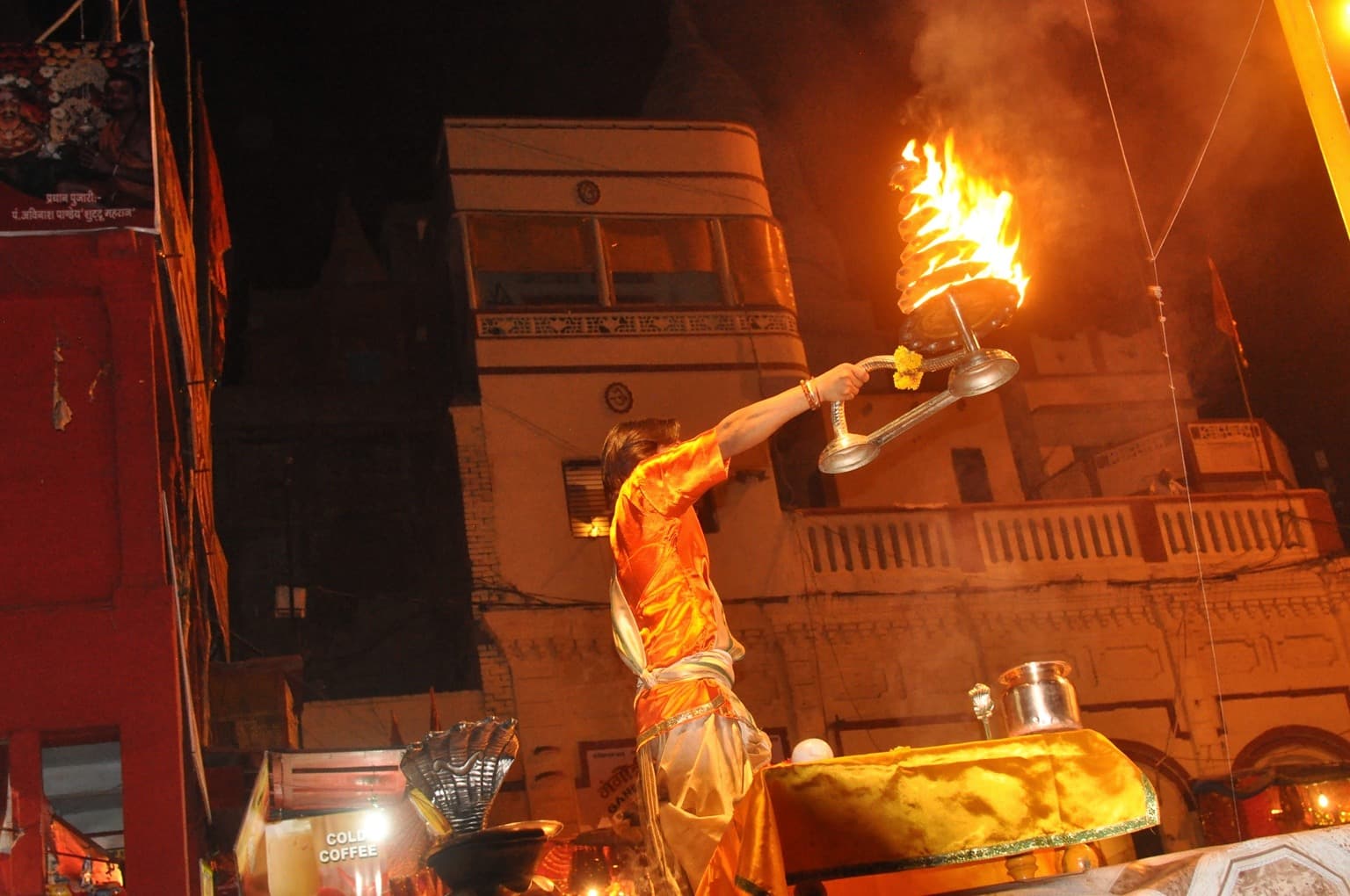
Aarti
Aarti is a Hindu ritual offering of light. During evening Ganga Aarti in Varanasi, priests use lamps and coordinated gestures in worship associated with the river. The ritual has a large public audience, but its devotional purpose should not be reduced to spectacle.
Puja
Puja is a broad term for Hindu worship and devotional practice. Its forms vary greatly by place, deity, household, temple and occasion. The archive should use the word only where the activity is documented or reliably identified, rather than applying it to any scene that simply appears religious.
Sadhu
A sadhu is a Hindu religious ascetic or renunciant. Clothing, hair, markings or setting may suggest that someone is a sadhu, but visual appearance alone is not always sufficient for a definitive identification. Captions should retain uncertainty where the archive record does.
Dhobi
Dhobi is a term associated with washing clothes and laundry work. On the ghats, the archive documents people washing cloth by the river. The occupational description should not be used to infer a person’s caste, community or family background without supporting evidence.
Darshan
Darshan refers to the act or experience of seeing and being seen by a deity, sacred image or revered person. It is an important idea in Hindu devotional life, but it is not a label for every act of looking at a shrine or image.
Why the glossary is cautious
These definitions provide orientation, not exhaustive accounts of complex traditions. Terms may carry different meanings in different communities and contexts. Where a photograph supports only a narrower description, the caption should remain narrower than the glossary.
Related documentary material
Return to experience
Explore this place →Explore the Knowledge Centre →Read documentary stories →Continue discovering →